Audit Lifecycle
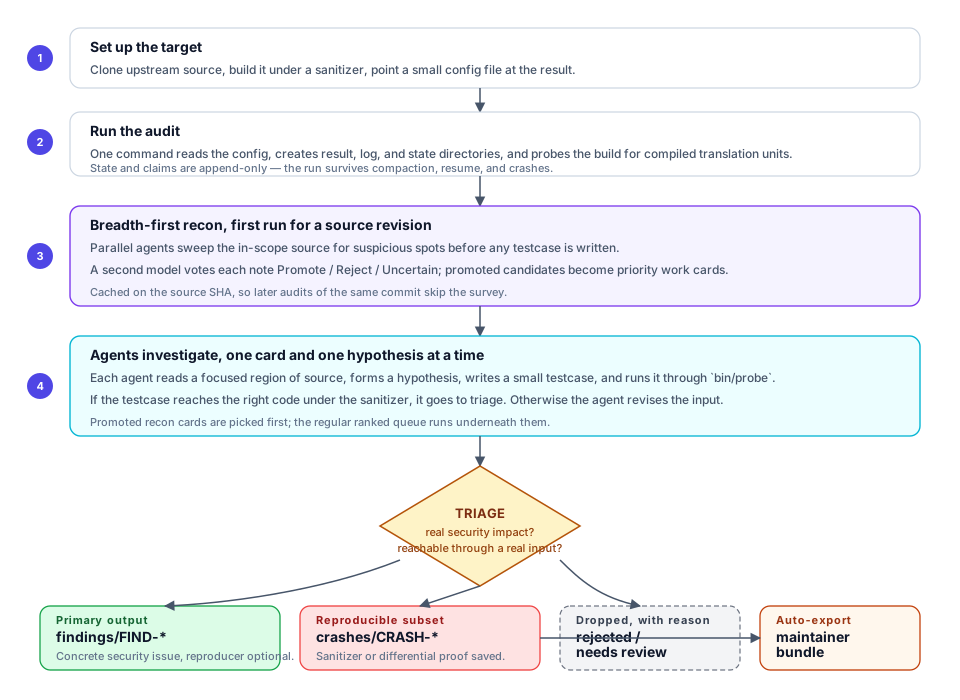
This page follows a run from "I have source I'm allowed to audit" to "a reviewer is looking at evidence". It is the operational narrative; the other concept pages explain individual components and design choices.
A useful run can end in either evidence lane:
- A written finding. A concrete security issue that does not depend on a
sanitizer-class crash lands in
findings/as a substantive report for independent review. A reproducer is useful, but optional. - A confirmed crash. When the testcase reproduces under a configured
sanitizer or race detector, it lands in
crashes/with the trace, the input, and areproduce.shthat rebuilds and re-runs it.
These are parallel lanes, not two copies of every issue. Managed-runtime panics and tracebacks normally become findings; sanitizer-class diagnostics and enabled race-detector reports become crashes.
Every accepted crash is automatically converted to a maintainer bundle
(REPORT.md, reproduce.sh, the sanitizer output, and the input) as part of
triage. There is no extra step to get that.
1. Set up the target
Setup creates two things:
targets/<target>/                   upstream source + sanitizer build
output/<target>/target.toml         generated config + threat model
The source checkout belongs to the upstream project. The harness reads it,
builds against it, and records its revision, but audit output stays under
output/.
If target.toml is missing, bin/audit --target <slug> seeds a starter config
automatically before loading it. You can also seed or refresh it explicitly
with bin/setup-target <slug>.
2. Build the sanitizer artifact
For native C/C++ targets, the harness needs a sanitizer build. Outside a
container the default location is targets/<target>/build-asan/; container
runs add ${AUDIT_BUILD_SUFFIX} so incompatible images use separate build
trees. target.toml points the harness at the binary inside it (asan_bin,
asan_lib). The same layout is used for browsers and generic CLI/library
targets.
- ASan is the only sanitizer enabled by default.
- UBSan, MSan, TSan, and Go's race detector are opt-in per target.
- MSan is recommended for self-contained libraries.
- UBSan and TSan are useful but need triage of their false positives.
See Sanitizer policy for the recommended posture.
Targets with [sanitizer].enabled = [] (typical for interpreted or managed
runtimes) skip sanitizer execution and ordinarily use the findings lane.
Runtime panics and tracebacks are report evidence, not sanitizer crashes. Go
is a hybrid: when [sanitizer].enabled = ["race"] and the configured command
emits WARNING: DATA RACE, the race report goes to crashes/.
Audit preflight can create or refresh ordinary non-browser native sanitizer
builds. Browser builds use their project tooling; registered language package
builds run explicitly through bin/setup-target <target> --build. After the
required build exists, refresh the generated config and review only unresolved
or incorrect values.
For ordinary native targets the regular sanitizer build stays the control,
while optional widened configurations take a minority of the audit's effort: a
bug behind a non-default feature is still a bug. A crash found there is
replayed against the regular build and triaged with both results. Set
build_widening = false in target.toml to skip this work.
3. Run the audit
bin/audit --target <slug> --backend <backend> starts a session. It reads
target.toml, detects the source revision, creates per-backend result and log
directories, and launches one or more agents. The optional iteration count
limits the run; omit it (or pass 0) to run continuously.
At preflight, the session copies the reviewed target configuration into its result tree. That snapshot is immutable for the run: change the source config for a future session rather than retargeting live agents underneath their recorded evidence.
Each agent is assigned a role and a strategy. Subsystem and starting point
come from the work queue when the agent claims its first piece of source.
Claims, notes, probe verdicts, and events append under state/; the current
hypothesis table is updated atomically, and work-cards.jsonl is rewritten
when the ranked queue refreshes. That structured state, not the agent's
transcript, is the source of truth across resume, compaction, and crash
recovery.
bin/audit --since <rev> runs a delta audit: the work cards cover only
the files changed in <rev>..HEAD, the files that call them (one hop over the
call-neighbourhood graph's certain edges; with no graph, the run says so and
covers the changed files alone), and one S1 card per commit in the range. The
window is the delta: no diversity floor, no expansion. The tree records the
base revision and changed-file set in state/run-config.json, and a resumed
run must keep the same HEAD and pass the same --since. A revision the
checkout cannot resolve (a shallow clone, a typo) stops the run rather than
silently widening it to a full audit. The tracked working tree must match
HEAD, because uncommitted code is outside the recorded <rev>..HEAD range.
An empty or exhausted delta stops instead of opening the primary agent's
ordinary whole-tree discovery slot.
4. Agents investigate
Each agent keeps one active investigation at a time, with other candidate hypotheses parked in its compact state:
- Take an assigned piece of source from the work queue.
- Pick or refine a hypothesis: a file, a function, a line, an input shape, an expected diagnostic.
- Read a small region of the source.
- If the source already establishes a concrete security issue, file the FIND now; a reproducer strengthens it but is not a precondition.
- Find a seed or write one testcase and run it immediately. If it does not reach the right code through the configured sanitizer or runner, revise the input and try again.
- Confirm a diagnostic before crash promotion, then move the artifact through its lane-specific validation.
Investigation depth follows evidence. One clean probe that instantiates every named boundary or call step can close a deterministic hypothesis. Timing-, race-, scheduler-, GC-, allocator-, re-entrancy-, and state-dependent triggers cannot be closed that way: they need repetition or different input shapes.
Closing one hypothesis does not retire its card. A dry card needs at least three clean probes across at least two distinct input shapes before it can be discarded, a minimum per card rather than a quota per hypothesis. That conclusion retires a concrete patch or site card. A broad whole-file card instead yields to fresher work and stays reofferable, because finite probes cannot prove its unexamined functions exhausted. A surface that no configured build or mode can execute at all is marked blocked rather than counted as clean evidence.
Work cards are leased so two agents do not step on each other. After a context compaction, the next iteration tells the agent which regions it has already read so it does not re-cover the same ground.
When an agent confirms a crash or finding in a subsystem, the queue relaxes the usual subsystem-diversity rule for that agent. Neighbouring cards are cheaper and more valuable once the agent has working data-flow context for the area.
5. Run the testcase
Every testcase runs through one execution gate: bin/probe. It reads the
testcase header, picks the right runner (browser, JS shell, generic CLI, C/C++
or language harness, or the configured [runner]), captures output, and
records the verdict in state/runs.jsonl.
Common outcomes:
| Outcome | Meaning | Action |
|---|---|---|
NO_EXEC |
Nothing ran: the testcase is missing, the probe refused the route, or the per-iteration sanitizer launch budget is exhausted (budget-exhausted). |
Fix the prerequisite, or wait for the next iteration. Not clean evidence; never a reason to discard a hypothesis. |
EXEC_FAIL |
The command started but produced no valid result. The recorded reason names the class (loader, usage, input-rejected, aborted, unverified-exit, or exit) and the repair it implies. |
Fix what the class names: the route, the argv, the harness, or the input. The launch still counts against the sanitizer budget. |
| Missed the target code | The coverage replay did not reach the named function. Browser and JS modes skip the sanitizer; a native target still runs it and records the miss beside the verdict. | Revise the input around the closest reached frame. |
| Clean hit | The code ran but the sanitizer was quiet. | Mutate input shape, state, timing, or allocator layout. |
| Sanitizer diagnostic | The input might be a crash candidate. | Confirm by re-running, minimise, and file under crashes/. |
Browser and JS modes use their configured coverage artifacts. A native target
is measured in the build-asan+cov sibling that bin/setup-target --build
and audit preflight build from the target's ASan recipe, replaying the
configured CLI or a coverage twin of the testcase's // HARNESS:. If that
sibling is absent, coverage is reported unavailable and the sanitizer run
proceeds; it is never counted as a miss.
Probe output is a contract, not a log: crash promotion requires saved sanitizer output on disk. Report-only FINDs go through FIND validation instead.
6. Triage
Triage decides whether an artifact is useful and in scope.
An ordinary audit schedules continuously. A slot that finishes a session relaunches at once if it has work, and nothing waits for the slowest peer. While slots are busy, a background sweep adjudicates the artifacts no live session can still write:
- a completed crash bundle, once the slot that filed it has no session in
flight and no other session has written into it (a
bin/probeskeleton or a held bundle stays with its owner until finished); - a finding, once every session whose own commands or file writes named it has ended, or, when no session named it, once every session still running started after it was filed.
A turn-capped session's continuation counts as the same session. A steward tick every few minutes scores the generation, rotates starved strategy lanes, and re-ranks the queue without stopping anyone. The one full pass over the whole tree, including orphan-testcase enforcement and corpus promotion (which touch a slot's own scratch), runs after the last slot drains. It reuses the cached verdicts, so what the sweeps settled costs no further review, and what they could not reach is judged there. Fixed-lane, delta, and ensemble runs keep the older cohort model with a pass at the end of every iteration.
For crashes, the gates are strict:
- there is a runnable testcase;
- sanitizer output is saved;
- the report fields are complete;
- the result is not an auto-quarantined low-value class: null dereference
(
0x0SEGV), OOM, assertion-only abort (ABRT with no sanitizer error),MOZ_CRASH/panic, or a plain stack overflow.
A trigger source outside the target's declared attacker surface is settled
by the source reviewer: when the reviewer agrees the fault needs something
outside those controls, the crash is rejected with a threat-model: reason;
when the reviews cannot place the trigger either way after the focused
resolution, it is rejected as unsettled. Either way the evidence moves to
crashes-rejected/ with the reason, and earns no numeric CVSS score and no
security yield.
Those checks are mechanical. On top of them, a reviewer reads the source and can still disprove a sanitizer-confirmed crash, but only on two independent rejections that each carry a concrete disproof. Silence keeps the crash pending while a review is still due. An inconclusive or split review receives the same focused resolution pass as a finding; one resolver Reject still cannot replace the two-Reject bar, and a resolver that cannot settle scope ends the claim as unsettled rather than leaving it without a verdict.
For findings, the gates are about substance:
- there is a report file at the FIND root;
- the report is substantive: a concrete location, an explicit issue class, and a rationale a reviewer can act on. A sanitizer reproducer is not required.
Because no sanitizer vouches for a finding, each report is read independently,
with none of the filing agent's context, and voted accept or reject. Two
accepts promote it; two rejects move it to findings-rejected/. A promoted
finding then receives source review of its trigger and exact claimed security
consequence. It is quarantined only when two anchored reviewers agree on a
concrete disproof; missing or ambiguous evidence fails open. An inconclusive
first review or a split receives one focused resolution pass carrying the
prior evidence; genuine remaining uncertainty stays visible and unjudged.
What happens to each artifact:
- Accepted crashes stay under
crashes/. - Hard rejections move to
crashes-rejected/with a reason rendered inREJECTED-CRASHES.html. - Runtime panics and tracebacks from findings-only targets remain report
evidence under
findings/; they were never sanitizer crashes. - Findings with no report get a
.needs-contentmarker and surface asNEEDS CONTENTinfindings/FINDING-CLUSTERS.html. - Findings rejected twice by the substance gate are quarantined to
findings-rejected/. They are not deleted, so you can review the reasoning.
Rejections are kept as reusable knowledge
Building a reproducer is the expensive half of an audit, so a disproof is
worth as much as a finding. When a reviewer rejects an artifact because its
triggering state is not attacker-reachable, the anchored reason is appended to
state/unreachable-routes.jsonl, and a later work card on any file that
disproof names renders it, newest first. Without this, later sessions can spend
time re-deriving the same disproved route on the same source.
Two properties keep the note honest:
- It rules out a route, not a file. The card is still assigned, and reaching the same code through a different attacker-controlled path still counts.
- It lives exactly as long as the rejection does. A rejected artifact is
the record of its own rejection, so when the gate requeues one whose verdict
went stale, the directory leaves
findings-rejected/and its route row is retired before that path can be reused. A new source revision alone does not make a rejection stale: the disproof is re-read against the lines it cites and stands while they still match byte for byte, so a pin change spends no review, and loses no advice, on a rejection the source still supports. Once an anchored line moves, the artifact is requeued and the note goes with it. Resumed runs reconcile stale trigger rejections before launching their first agents, so an obsolete note cannot survive even one cohort. There is no tombstone, and no second copy of the gate's validity rules to drift out of step.
Severity annotation is best-effort post-processing on top of all this. A failed scoring run does not remove an otherwise complete crash or finding.
7. Export to a maintainer bundle
Triage automatically runs bin/export-repro on every accepted crash. After
bundling, each crashes/CRASH-* directory contains:
REPORT.md          one-page summary
REPORT.html        generated sibling
reproduce.sh       ./reproduce.sh /path/to/source
input.<ext>        the testcase bytes
harness.{c,cc,cpp,cxx} only when the bug uses a C/C++ harness
sanitizer.txt      saved sanitizer output
patch.diff         optional candidate fix
validation.json    the publication decision, bound to this evidence
severity.json      only when a current reportable score exists
.audit/            original agent-authored files, kept for provenance
A maintainer runs:
and sees the same sanitizer output against a clean checkout. The first export happens during triage without operator action; Maintenance commands shows how to re-run it after editing a bundle.
8. Where to look
The paths worth knowing during a session:
output/<target>/CRASH-CLUSTERS.html
output/<target>/FINDING-CLUSTERS.html
output/<target>/<backend>/results/crashes/
output/<target>/<backend>/results/findings/
output/<target>/<backend>/results/crashes-rejected/REJECTED-CRASHES.html
See Artifact layout and Commands for the full inspection toolkit.